Flexural buckling of an IPE 330 column
How much axial force can an IPE 330 column carry if it buckles about its weak axis? A short worked example with the numbers shown.
The section
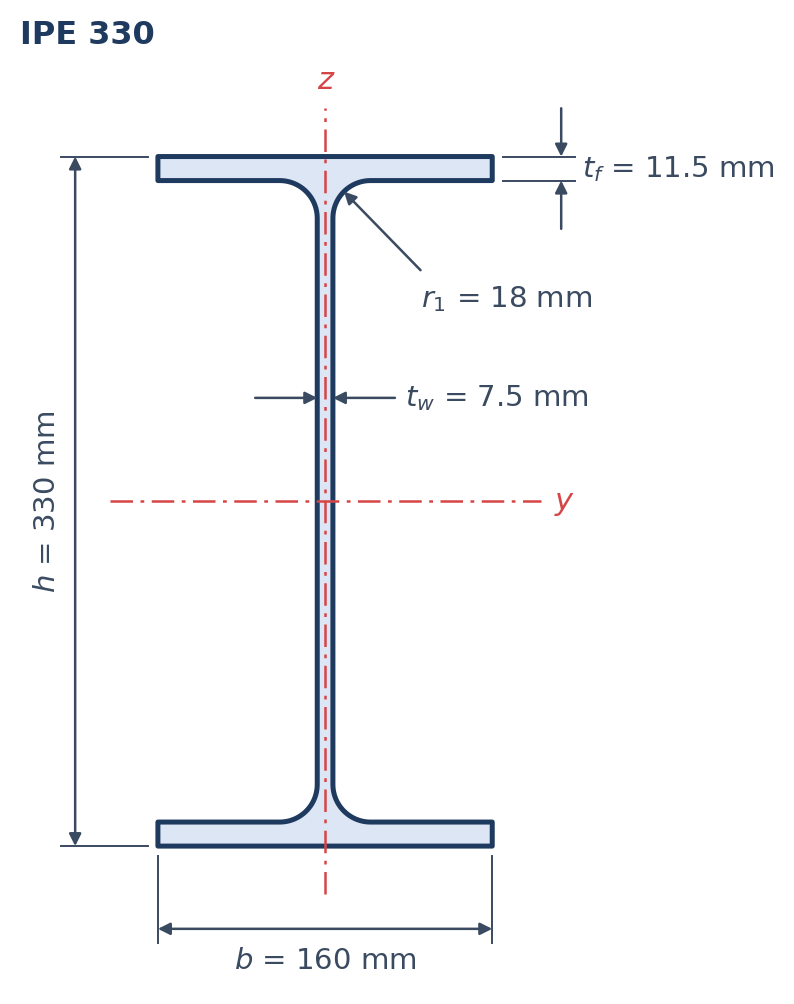
The area is \(A = 62.6\) cm² and the radii of gyration are \(i_y = 137\) mm and \(i_z = 35.5\) mm. The steel is S235 (\(f_y = 235\) N/mm²) and \(\gamma_{M1} = 1.0\).
Relative slenderness
With the squash load \(N_{pl} = A f_y = 1471.1\) kN and \(\lambda_1 = 93.91\):
\[
\bar{\lambda}_y = \frac{6000/137}{93.91} = 0.466
\qquad
\bar{\lambda}_z = \frac{3000/35.5}{93.91} = 0.900
\]
Reduction factor and resistance
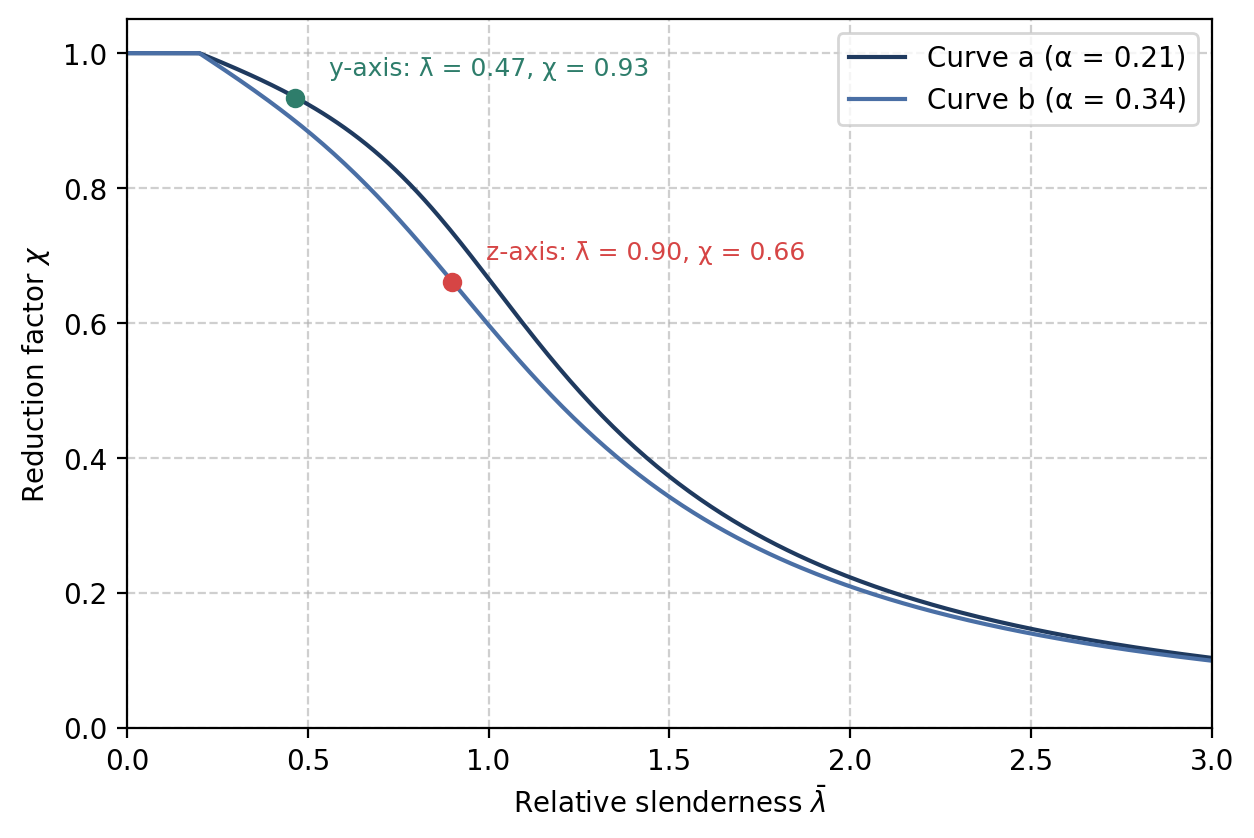
| Axis | Curve | \(\bar{\lambda}\) | \(\chi\) | \(N_{b,Rd}\) [kN] |
|---|---|---|---|---|
| y (6 m) | a | 0.466 | 0.934 | 1374.6 |
| z (3 m) | b | 0.900 | 0.661 | 972.8 |
Result
The weak axis governs. The column can carry \(N_{b,Rd} = 972.8\) kN, which is 66 % of the squash load.
Take-away
A short buckling length about the weak axis matters more than the strong-axis length: here half the length about z still gives the lower resistance.
The full derivation is in the chapter Flexural buckling.